
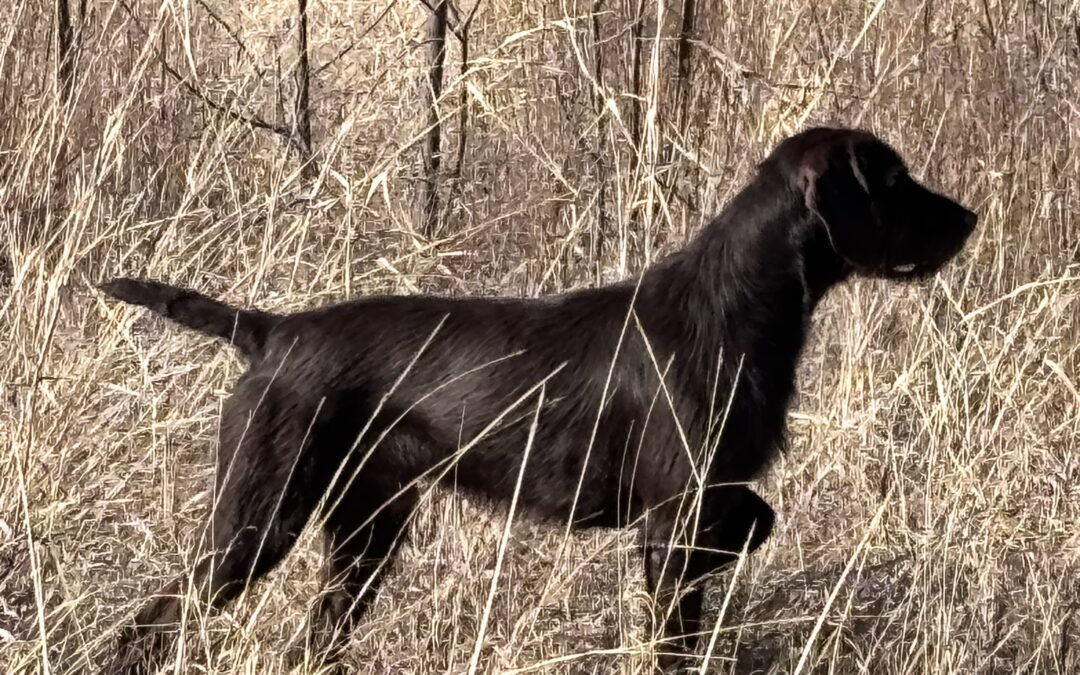
Whether you are planning to run your dog in an advanced hunt test or not, training your dog to heel on command will afford you more control over your dog and keep your hunting companion a little safer when the command is needed in the field. Like other obedience commands, it will also ensure your family enjoys your dog more. For some dogs this training comes easy and for others it takes a little more work.
You may be wondering at what point in the training sequence I work to establish the heel command with my dogs. I often will establish the heel command prior to embarking on the conditioned retrieve (otherwise known as Force Fetch). I generally will have the dog heeling pretty well by around 11-12 months old, and then roll right into the conditioned retrieve. Why do I like to have the heel command established before the conditioned retrieve training? Because, if I have heel established before conditioned retrieve work, then the dog will already know how to come to heel at my side facing the same direction as myself when I begin adding birds and pressure during fetch work. Developing a well-trained dog is like building a house, one step at a time. After the heel command is established, they are ready for the conditioned retrieve. After the conditioned retrieve is established, the dog is ready for steadiness work in the field. Why do I like to have the dog reliably retrieving to hand before steadiness work? I like to have a good solid retrieve and delivery before I steady my dogs to wing-shot-fall in the field so that when they do everything right when on point (and hold point through the fall), then they know exactly what is expected when I give the “fetch” command. I don’t want to have to put pressure on them to both be steady and retrieve while working the same bird, if possible. This way, when the dog does well and is steady through the fall, they truly feel as though they are rewarded by getting to retrieve, since there is less critiquing of how they retrieve.
Anyway, let’s get into the logistics of teaching a dog to heel. Prepare to spend about 10 minutes 1-2 times per day over the course of about a couple of weeks to work on heel. You, of course, will need to periodically reinforce this command throughout the dog’s life to keep them sharp, which is the case with any obedience command. I suggest a 6 ft leash. You will also need to purchase an all-metal pronged collar (can be purchased at most pet supply stores) for the initial stages of teaching your dog to heel. This collar pinches the dog’s neck as soon as they tug and allows for an immediate and consistent correction.
The goal of heel training is to have your dog walk with their head/shoulder in line with your knee. Your dog needs to learn to respond to your movements. They need to turn when you turn and walk at your pace. As you begin this training, expect your dog to try to move ahead of you or tug on leash. When teaching heel, the biggest mistake I made with my first dog, a high drive field trial bred German Shorthair, is I kept walking in the same direction and simply tugged back on the leash to attempt to get her back in line with me when she attempted to surge ahead.
ABOUT FACE/180
I suggest that you do NOT continue walking in a straight line when your dog moves ahead of you. Instead, immediately turn 180 degrees and walk in the opposite direction. This will be better understood by your dog and will save your shoulder and elbow from injury. When you about-face, simultaneously say “no heel,” give a slight tug, and slap your thigh with the hand on the side that you want them to heel on. Keep initiating an about-face/180 degree turn every time your dog’s head gets too far ahead of your knee. (Note: Usually with all this initial training on heel I am turning away from the dog. I heel my dog on my left side, so I turn with my right shoulder going back to initiate a 180 degree turn.)
The first several sessions, you likely will NOT leave your yard because with a few steps in each direction the dog will surge ahead of you. That is to be expected at first. Timing is important with all of this. Verbally praise your dog when they move back into the heel position. Don’t overdo it. A simple, good boy or good girl is enough. Take note, some dogs sulk a little at first and hang back behind you after you turn a few times. When they do, I suggest you not use the leash to pull them up to your side. Simply encourage them through an upbeat/positive tone of voice (“come on”) and a few slaps of your thigh and they will move up again beside you. At this point, say “good” and resume walking in a straight line until they surge ahead again, at which point you will do another about face. Repetitively follow the sequence outlined above until they are cueing off you and turning when you turn. You can also throw in impromptu about faces even when they are heeling well just to keep them guessing.
SQUARE PATTERN
Once your dog is heeling well in a straight line and is cuing off you by turning when you turn, then you are ready to change things up. Now you will heel your dog in a Square Pattern, walking about 10 yards in each direction. Initiate a 90-degree turn to initiate the square pattern and say “heel” upon turning. You’ve laid the groundwork, so it won’t take long before your dog is doing a square pattern with you at heel. You can vary the length that you walk between each turn after its obvious they know the drill. You can now turn every 15 or 20 yards or even shorten it and turn every 5 yards for a smaller square for a session or two. Changing it up is important to keep the dog guessing and watching you closely.
REVERSE SQUARE PATTERN
Your dog is likely heeling well while doing a square pattern, with you turning away from them. You will now do squares of varying lengths but turn towards your dog each time. At first, they will bump into your leg because they are used to always turning one direction. Its fine, just be patient. When this happens just bump them with your knee in the direction you want to go and give a slight tug in that direction on the leash. This may take some time, but your pup will learn to heel with you no matter which way you decide to turn.
FIGURE EIGHT PATTERN
Your dog should be doing straight lines and squares in both directions. Now, you will do figure eights with your dog at heel. Figure eights of varying sizes are good to use in the training of heel, because with each figure eight your dog must turn in both directions while responding to your movements. Start with smaller figure eights and work up to larger ones is my suggestion. (Note: With all of these steps (e.g., Straight line, Square, Figure Eights, etc., if your dog surges ahead, you can always initiate an about face, give a slight tug, and say heel. Then, go back into the square or figure eight pattern that you’re working on.)
RANDOM AT HEEL
You started with the Straight Line stage, then went to Square Pattern stage, and have just completed the Figure Eight stage of teaching Heel. Many folks stop here. I think the next stage is very important. It will lead to a dog that watches you very closely. After completing the next stage, most dogs become much more responsive while heeling. The next stage is called “Random At Heel.” You will say heel and start walking, but instead of predictably doing a straight line, square or figure eight you will mix it up. During Random Pattern your dog must focus intensely on you. Sometimes you will go left, sometimes right after 10 yards of walking, you might walk 2 more yards and do an about face, then walk 15 more and do a figure eight, then 5 yards and initiate a square, then maybe after 10 more yards and engage a figure eight, then maybe another about face. You get the point. This is a very important final step while doing yard work on heel.
INCREASING DISTRACTIONS
If you have taken your time your dog should be doing well. Most of this work should be done in your yard at first. You will need to with your dog in at least four other locations until your dog is solid in each. You will also want to work on it while other people are around as well as other dogs and distractions, etc. You can go to parks while kids are playing nearby to reinforce the heel command with distractions, soccer games, training days with other dogs and people, etc. Slowly increase the level of distraction until they will heel pretty much anytime, anywhere when asked to do so.
TRANSITION TO E COLLAR
Since you have done a good job and followed the plan outlined here you should be able to transition your dog from the pronged collar to the E collar with very little hassle. With the e collar on your dog’s neck attach the leash to the flat buckle collar they normally wear (i.e., there is no longer any need for the pronged collar at this point). In the same way you used the pronged collar to make a correction, you now use stimulation from the e collar to make the correction. If your dog lunges ahead simply do an about face, tug and apply a light stimulation with the E Collar. I typically use continuous stimulation and guide them back into the heel position with the leash, at which point I stop stimulation and praise them. They will want to avoid the stimulation and turn with you in short order because you have laid a solid foundation in prior training as outlined here. As was done using the pronged collar, do some sessions working on straight lines, squares, figure eights, and random pattern, but now using the e collar and leash attached to flat collar. Any time your dog leaves the zone for heeling properly apply low e collar stimulation while simultaneously changing directions and gently guide them back into position with the leash. When they are in the “heel zone,” immediately stop collar stimulation and provide a verbal praise, such as “good boy or girl.” With some repetition, you will be able to take off the leash and heel your dog without the leash.
CONCLUSION
The “Heel” command is a useful command that can be used in a variety of settings and scenarios. Your family will enjoy your dog around the house and on daily walks if your dog will reliably walk without tugging. In addition, it also is a very important command during various hunting scenarios, such as when you and your hunting partners are standing near your hunting rig before or after a hunt or while creeping up on wary ducks loafing on a pond or river when remaining stealthy is often important to get a clean shot. It is also an important component in the Cross Timber Gundogs’ suggested training sequence for advanced versatile hunt tests.